
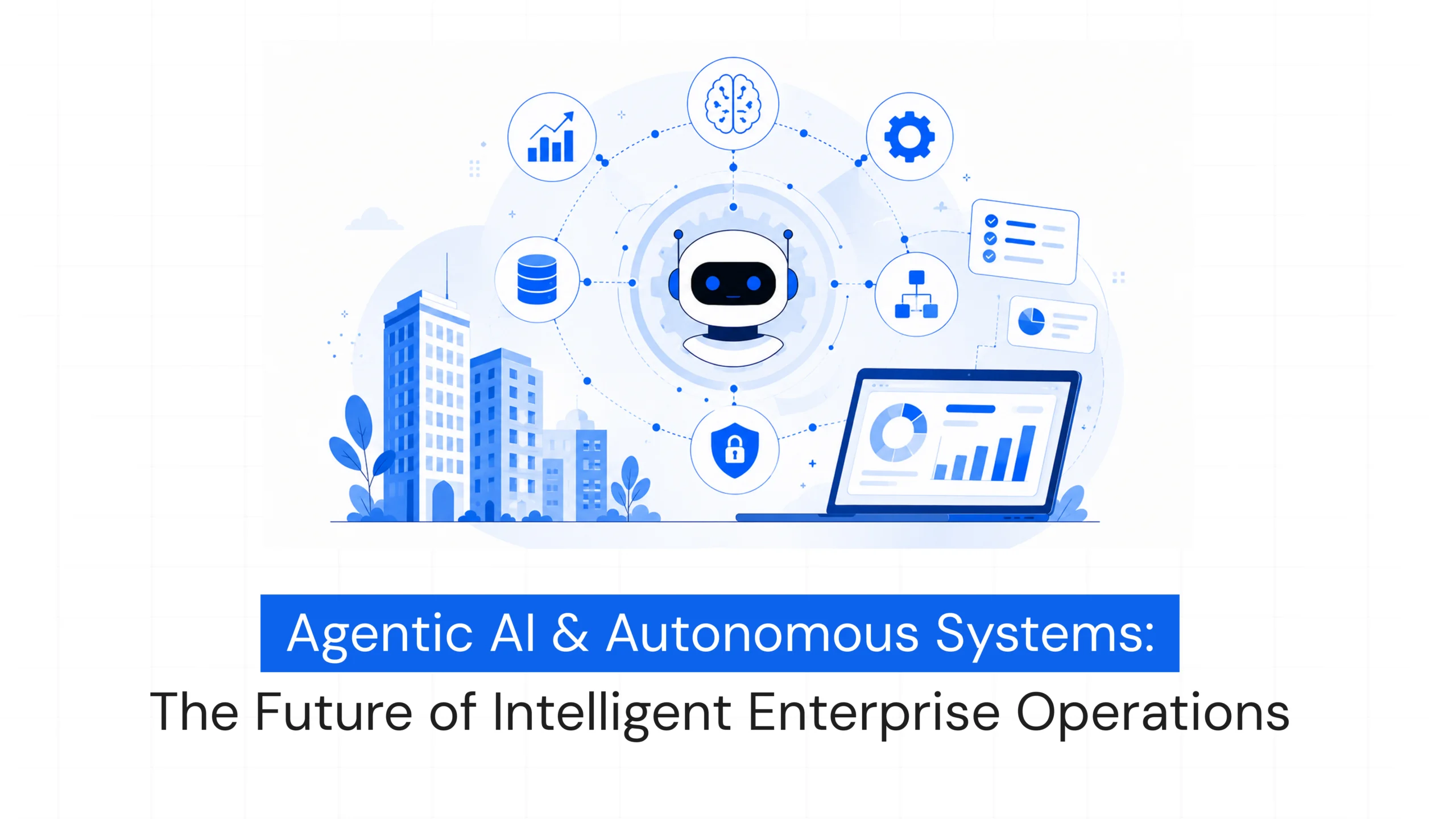
Artificial Intelligence is rapidly evolving beyond traditional automation and chatbot interactions. In 2026, businesses are entering a new era powered by Agentic AI and autonomous systems
Agentic AI & Autonomous Systems: The Future of Intelligent Enterprise Operations
- May 22, 2026
- Pavithra R
- 10:00 am
Post Views: 108
Introduction
Artificial Intelligence is rapidly evolving beyond traditional automation and chatbot interactions. In 2026, businesses are entering a new era powered by Agentic AI and autonomous systems — intelligent technologies capable of making decisions, executing tasks, adapting to environments, and operating with minimal human intervention.
Unlike conventional AI systems that respond only to prompts or predefined workflows, Agentic AI introduces goal-oriented intelligence. These AI systems can plan actions, analyze situations, solve problems, and complete multi-step tasks independently.
As enterprises continue to scale their digital operations, Agentic AI is becoming a core driver of intelligent automation, operational efficiency, and real-time business decision-making.
From customer support and IT operations to finance and logistics, autonomous AI systems are reshaping how modern organizations function.
What Is Agentic AI?
Agentic AI refers to artificial intelligence systems designed to operate autonomously while pursuing specific goals or objectives.
Traditional AI systems usually perform limited tasks based on direct human instructions. Agentic AI, however, can:
- Understand objectives
- Analyze context
- Make decisions
- Execute workflows
- Learn from outcomes
- Adapt dynamically
These systems behave more like intelligent digital agents rather than passive software tools.
For example, instead of simply answering customer queries, an AI agent can:
- Understand customer intent
- Access internal systems
- Resolve issues automatically
- Schedule follow-ups
- Update databases
- Escalate critical cases when necessary
This level of autonomy significantly reduces manual effort while improving operational speed and accuracy.
Understanding Autonomous Systems
Autonomous systems are AI-powered environments capable of operating with minimal human supervision.
These systems continuously:
- Observe data
- Analyze situations
- Make decisions
- Execute actions
- Improve performance over time
Autonomous systems combine multiple technologies such as:
- Artificial Intelligence
- Machine Learning
- Real-time analytics
- Automation platforms
- Intelligent agents
- Predictive systems
Modern enterprises are increasingly adopting autonomous systems to improve operational scalability and efficiency.
Examples of autonomous systems include:
- AI-powered customer service platforms
- Autonomous cybersecurity monitoring
- Smart manufacturing systems
- Intelligent supply chain management
- AI-driven IT operations
- Autonomous financial monitoring systems
These systems help businesses move from reactive operations toward predictive and intelligent enterprise management.
The Evolution from Automation to Autonomy
Traditional automation focuses on repetitive rule-based tasks. While effective, these systems often lack flexibility and contextual understanding.
Agentic AI introduces a major shift from automation to autonomy.
Traditional Automation:
- Rule-based
- Predefined workflows
- Limited adaptability
- Human-dependent decision-making
Agentic AI Systems:
- Goal-driven execution
- Adaptive decision-making
- Real-time learning
- Context-aware operations
- Autonomous task management
This transformation allows enterprises to build systems that can respond intelligently to changing business environments.
Key Technologies Behind Agentic AI
Several advanced technologies power modern Agentic AI systems.
Large Language Models (LLMs)
LLMs enable AI systems to understand human language, generate responses, summarize information, and perform reasoning-based tasks.
Machine Learning
Machine learning allows AI systems to improve performance through data analysis and continuous learning.
AI Agents
AI agents are intelligent software entities capable of executing tasks autonomously across enterprise workflows.
Real-Time Analytics
Real-time data processing enables autonomous systems to make faster and more accurate decisions.
Workflow Automation Platforms
Automation platforms integrate AI with enterprise processes to streamline operations across departments.
API Integrations
APIs allow AI systems to connect with enterprise software, databases, communication tools, and cloud platforms.
Together, these technologies create highly intelligent enterprise ecosystems.
Enterprise Applications of Agentic AI
Businesses across industries are integrating Agentic AI into their operations.
Customer Support
AI agents can resolve customer issues, generate responses, prioritize tickets, and manage communication workflows without constant human involvement.
IT Operations
Autonomous monitoring systems can detect performance issues, identify security threats, and initiate corrective actions automatically.
Human Resources
AI systems assist with candidate screening, interview scheduling, onboarding workflows, and employee support.
Finance
Financial organizations use autonomous AI systems for fraud detection, reporting automation, and predictive financial analysis.
Supply Chain Management
AI-powered systems optimize inventory management, predict demand fluctuations, and improve logistics coordination.
Healthcare
Healthcare organizations use autonomous AI for patient monitoring, diagnostics support, workflow management, and operational optimization.
Human Oversight in Autonomous Systems
Despite rapid advancements, human oversight remains essential in AI-driven enterprises.
Agentic AI systems are designed to support human decision-making — not fully replace it.
AI excels at:
- Data processing
- Repetitive workflows
- Pattern recognition
- Predictive analysis
- Real-time monitoring
Humans continue to play critical roles in:
- Strategic planning
- Leadership
- Ethical decision-making
- Creativity
- Governance
- Risk management
The most successful organizations are adopting collaborative models where humans and AI systems work together to improve operational efficiency and innovation.
Benefits of Agentic AI & Autonomous Systems
Organizations adopting autonomous AI systems gain several advantages.
Improved Operational Efficiency
AI systems reduce manual workloads and streamline complex workflows.
Faster Decision-Making
Real-time analytics enables quicker and more accurate business decisions.
Scalability
Autonomous systems can handle large-scale operations without significantly increasing operational costs.
Continuous Operations
AI systems can operate 24/7 without downtime, improving service availability and productivity.
Enhanced Customer Experience
Intelligent AI agents provide faster support and personalized interactions.
Predictive Intelligence
Businesses can identify risks, opportunities, and operational issues before they escalate.
Challenges and Risks
While Agentic AI offers major benefits, organizations must also address several challenges.
Data Privacy and Security
AI systems process large amounts of sensitive enterprise data, increasing cybersecurity concerns.
AI Governance
Organizations need clear governance policies to ensure responsible AI usage.
Ethical Concerns
Bias, transparency, and accountability remain important issues in autonomous decision-making systems.
Integration Complexity
Integrating AI with legacy enterprise systems can be technically challenging.
Overdependence on Automation
Excessive automation without human oversight may increase operational risks.
Enterprises must balance innovation with responsible AI management.
The Future of Autonomous Enterprises
The future of enterprise operations is becoming increasingly autonomous and AI-driven.
Organizations are moving toward:
- AI-native infrastructure
- Self-managing workflows
- Intelligent digital ecosystems
- Autonomous enterprise operations
- AI-powered decision systems
In the coming years, AI agents may function as digital coworkers capable of independently managing multiple business processes.
Businesses that successfully adopt Agentic AI will gain competitive advantages through:
- Faster operations
- Better scalability
- Intelligent automation
- Improved customer experiences
- Data-driven decision-making
Agentic AI is no longer a futuristic concept — it is rapidly becoming a core part of enterprise transformation.
Conclusion
Agentic AI and autonomous systems are redefining how modern enterprises operate. Businesses are evolving beyond traditional automation toward intelligent systems capable of decision-making, workflow execution, and adaptive operations.
By combining AI agents, real-time analytics, automation platforms, and human oversight, organizations can build highly scalable and intelligent enterprise ecosystems.
As AI technology continues to advance, enterprises that embrace autonomous systems early will be better positioned to lead in the future digital economy.
The future of business operations is not simply automated — it is autonomous.
Latest Blogs
LLM Security: Risks, Defenses, and Best Practices
August 27, 2026
AI-Powered Cyberattacks: What Developers Need to Know
August 18, 2026
Schedule your free consultation and get expert guidance
FAQ
What is Agentic AI?
Agentic AI refers to AI systems capable of autonomously making decisions, executing tasks, and adapting to changing situations while pursuing specific goals.
How is Agentic AI different from traditional AI?
Traditional AI responds to predefined instructions, while Agentic AI can independently plan, reason, and execute multi-step workflows.
What are autonomous systems?
Autonomous systems are AI-powered systems capable of operating with minimal human intervention through intelligent decision-making and automation.
Where is Agentic AI used?
Agentic AI is used in customer support, IT operations, healthcare, finance, HR management, logistics, and enterprise automation.
Will autonomous AI replace human workers?
AI is primarily designed to automate repetitive and data-heavy tasks, while humans continue handling strategy, leadership, creativity, and governance.
What are the benefits of autonomous systems?
Benefits include improved efficiency, scalability, faster decision-making, predictive intelligence, and continuous operations.
What challenges do enterprises face with Agentic AI?
Common challenges include data privacy, AI governance, integration complexity, ethical concerns, and overdependence on automation.
What is the future of Agentic AI?
The future of Agentic AI includes autonomous enterprise operations, intelligent digital ecosystems, AI coworkers, and self-managing business workflows.