
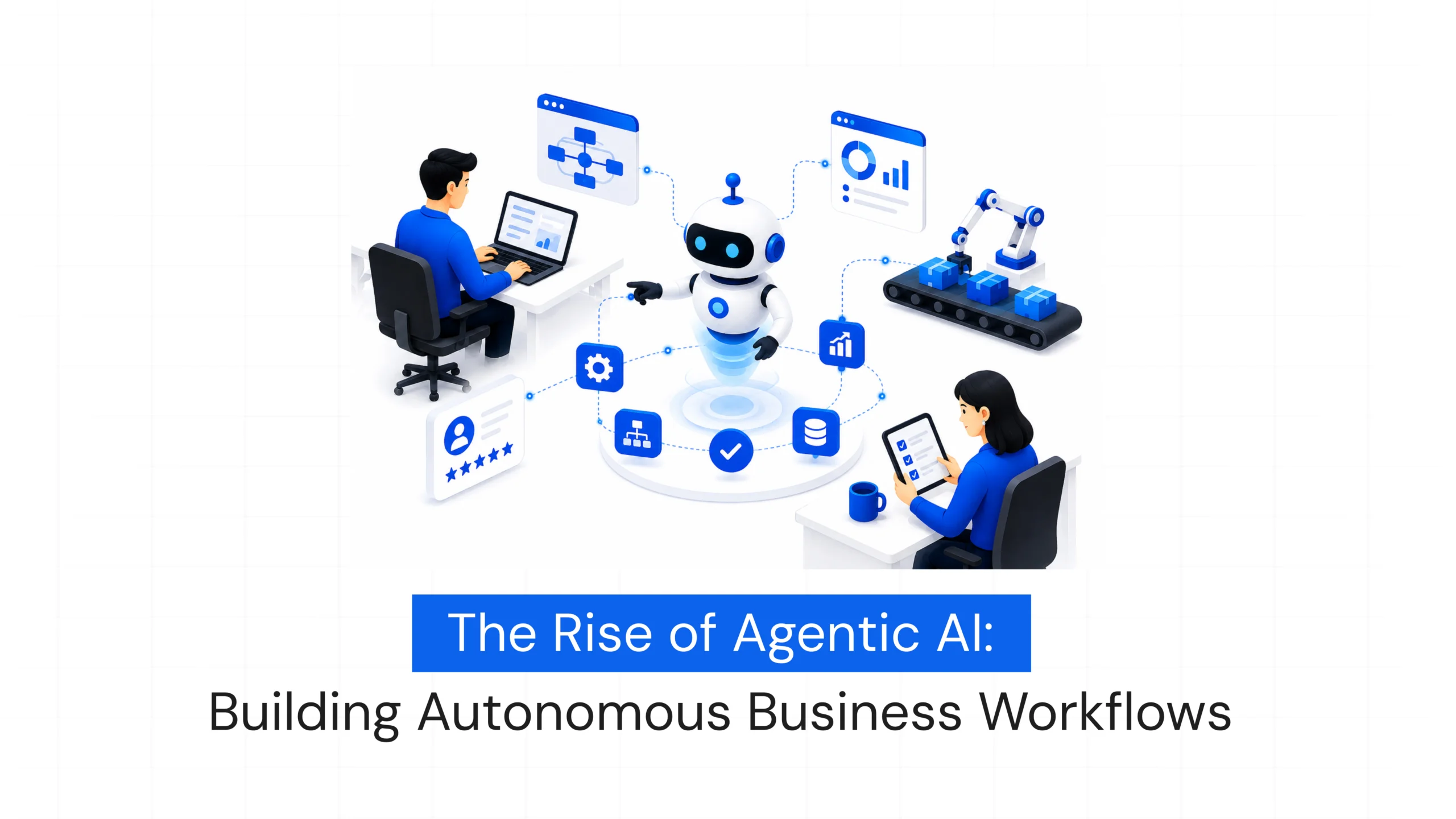
Businesses have been seeking to optimize their operations and provide better customer experiences. While automating repetitive processes can increase efficiency, it often still requires human input to complete various tasks. A relatively new innovation, known as agentic AI, enables independent completion of a business process.
The Rise of Agentic AI: Building Autonomous Business Workflows
- August 5, 2026
- Pavithra R
- 10:00 am
Post Views: 85
Introduction
Businesses have been seeking to optimize their operations and provide better customer experiences. While automating repetitive processes can increase efficiency, it often still requires human input to complete various tasks. A relatively new innovation, known as agentic AI, enables independent completion of a business process.
Unlike traditional AI systems that simply follow specific instructions, agentic AI completes entire workflows by reasoning, planning, adapting, and making decisions along the way.
From customer support to supply chain management, the application of agentic AI has enormous potential in streamlining business operations.
What is Agentic AI?
Agentic AI is a developing area of artificial intelligence that enables AI agents to act independently and complete a certain set of instructions. While a chatbot can answer a customer’s questions, an AI agent can receive a request, identify a customer, research a problem, update systems, reply to the customer, and notify relevant parties. In essence, agentic AI does not simply carry out instructions but plans and completes an entire workflow with little human interaction.
Some of the characteristics of agentic AI include:
– Ability to understand a business goal
– Breaking a large-scale task into smaller, more efficient subtasks
– Using logic and data for decision-making
– Acting independently
– Interacting with different systems and tools
– Adapting to new situations and learning from previous activities
Essentially, agentic AI transforms from simply doing to actually doing business.
Traditional AI vs Agentic AI
While traditional AI and agentic AI share similarities, such as relying on artificial intelligence, these systems differ significantly in their approach to problem-solving. This divergence manifests in numerous areas, including the scope of available functions and approaches to decision-making, which will be discussed further.
It should be understood that traditional AI is designed to fulfill certain tasks upon receiving particular commands. Therefore, it is primarily used to answer specific questions and perform various routine activities. In contrast, agentic AI focuses on problem-solving on a larger scale. It does not follow strict guidelines and can operate independently, making decisions on its own.
To put the difference between these two types of AI in perspective, it should be mentioned that traditional AI assists humans in accomplishing their tasks, while agentic AI helps organizations achieve their goals. Thus, the latter goes beyond simply completing one or more actions performed by people and moves toward fully automated operations, which makes it revolutionary in terms of business processes.
Why Businesses are Turning to Agentic AI
As businesses grow and scale, their operations become more complex with the addition of new processes and tools. Even when these steps are automated, employees often spend considerable time performing various steps to complete one task. As the business continues to scale, some of the common challenges include:
– Delays in operations
– Repetitive, tedious tasks
– Higher costs due to inefficiency
– Increased human errors
– Slow decision-making processes
Agentic AI can help with addressing these challenges.
Rather than simply automating individual steps in a process, an AI agent can complete an entire process by itself, thereby helping streamline operations. As a result, businesses benefit from fewer delays and errors while reducing operations costs and time spent on repetitive tasks.
Agentic AI in Action
Agentic AI has significant applications in a wide range of industries and operations. Some of the examples of how agentic AI can be implemented in business processes include:
Customer Support
An AI agent can address a customer request by determining the nature of the problem, retrieving or researching information, identifying solutions, implementing the resolution if appropriate, updating relevant systems, and notifying the customer. In essence, what would have been a multi-step and possibly multi-person process can be carried out by one AI agent, often with minimal human input.
Recruitment
An AI agent can facilitate the recruitment process from screening candidates and selecting the most suitable applicants to scheduling interviews and following up on the process. This not only makes the process more efficient but also ensures that recruiters can spend more time focusing on the most suitable candidates rather than administrative tasks. In turn, this results in improved candidate experiences and more efficient hiring practices.
Supply Chain
The management of inventory and supply chains can also be automated through the use of AI agents. Rather than simply analyzing or predicting demand, AI agents can monitor the demand in real-time, analyze and compare available options, and update systems and purchase orders accordingly. This helps ensure that there is a continuous supply of products with minimal interruptions in the process.
Key Features of Agentic AI
Agentic AI possesses several key features that distinguish it from other AI technologies and contribute to its potential to revolutionize business operations, including:
Goal-oriented
Rather than simply responding to individual commands, agentic AI has the capacity to plan, reason, adapt, and make decisions toward accomplishing specific business goals. In essence, an AI agent can replace multiple steps in completing an end-to-end digital transaction.
Intelligent decision-making
An AI agent can make decisions based on the information at hand, previous experiences, and the most relevant rules in a given situation.
Memory
Agentic AI has memory, thus enabling it to learn from previous activities and interactions.
Integration capabilities
Agentic AI can be integrated into different aspects of modern business operations. The AI agent can interact with various digital tools and systems, including CRM, ERP, email, databases, cloud services, and APIs.
Continuous improvement
Agentic AI is dynamic and can evolve and grow to support more complex aspects of business operations. As a result, businesses can continuously optimize operations by leveraging the improvements made in agentic AI.
Industries that can Benefit from Agentic AI
Agentic AI has the potential to transform operations in many industries, including:
– Healthcare – Patient bookings, medical documentation, and insurance claims
– Banking and finance – Fraud detection, loan approval, and compliance monitoring
– Manufacturing – Maintenence, production planning, and inventory management
– Retail and e-commerce – Personalization, inventory forecasting, and customer support
– Logistics – Shipment tracking, routing optimization, and warehouse automation
Advantages of Agentic AI
The businesses that have already implemented agentic AI have reported numerous benefits, including:
– Faster decision-making
– Higher employee productivity
– Lower operational costs and expenses
– Enhanced customer experiences
– Greater scalability and flexibility
– 24/7 operations
By simply replacing individual transactions that would have required human effort with a single AI agent, businesses can improve operations while providing better work experiences for employees.
Considerations when Adopting Agentic AI
In essence, agentic AI is an opportunity for businesses to optimize operations and deliver better experiences. However, like any other innovative technology, it is critical to approach the adoption process with caution. As a result, businesses considering investing in agentic AI should prioritize understanding how to implement it to maximize opportunities while minimizing risks. Some of the key considerations when adopting agentic AI include focusing on:
– High-quality and reliable data
– AI security and trust
– Ethical and responsible use of AI
– Human oversight and control
– Regulatory compliance with relevant laws
Ultimately, the objective is to ensure that agentic AI supports business operations without doing away with the human element.
How Kirshi Technologies Can Help Implement Agentic AI
At Kirshi Technologies, we believe that agentic AI is a powerful tool in transforming business operations, and we offer a wide range of services, including evaluating opportunities for leveraging AI-driven automation, building robust digital ecosystems, and implementing end-to-end digital solutions.
Our team of experts can help organizations realize the potential of agentic AI in enhancing customer experience, improving operational efficiency, and supporting other business objectives. Whether looking to optimize customer support, build an e-commerce platform, or develop enterprise AI applications, we can assist in identifying the best business solutions for specific organizational needs.
Final Thoughts on Agentic AI
Agentic AI represents the future in artificial intelligence and has the potential to support businesses in delivering superior results. Unlike traditional AI, agentic AI can be programmed to carry out a full set of instructions, ranging from reasoning to making decisions. As a result, businesses that start adopting this innovation today will be well-positioned to achieve superior results tomorrow.
Latest Blogs
Agentic AI vs Generative AI: What’s the Difference?
October 1, 2026
AI Observability: How to Monitor and Manage AI Systems in Production
September 16, 2026
Schedule your free consultation and get expert guidance
FAQs on Agentic AI
What is agentic AI?
Agentic AI refers to artificial intelligence agents that can make decisions and complete processes with little human interaction to achieve a certain business goal.
How is agentic AI different from traditional AI?
Unlike traditional AI systems, agentic AI operates with minimal human input and can achieve business targets by making appropriate decisions.
Which industries can benefit from agentic AI?
Healthcare, the finance industry, the logistics sector, the retail sector, manufacturing companies, and various organizations that provide customer support can benefit from agentic AI.