
By 2026, Artificial Intelligence shifts from background tool to core structure in business tech setups. Instead of only handling repetitive tasks or data review, it drives how companies run day to day.
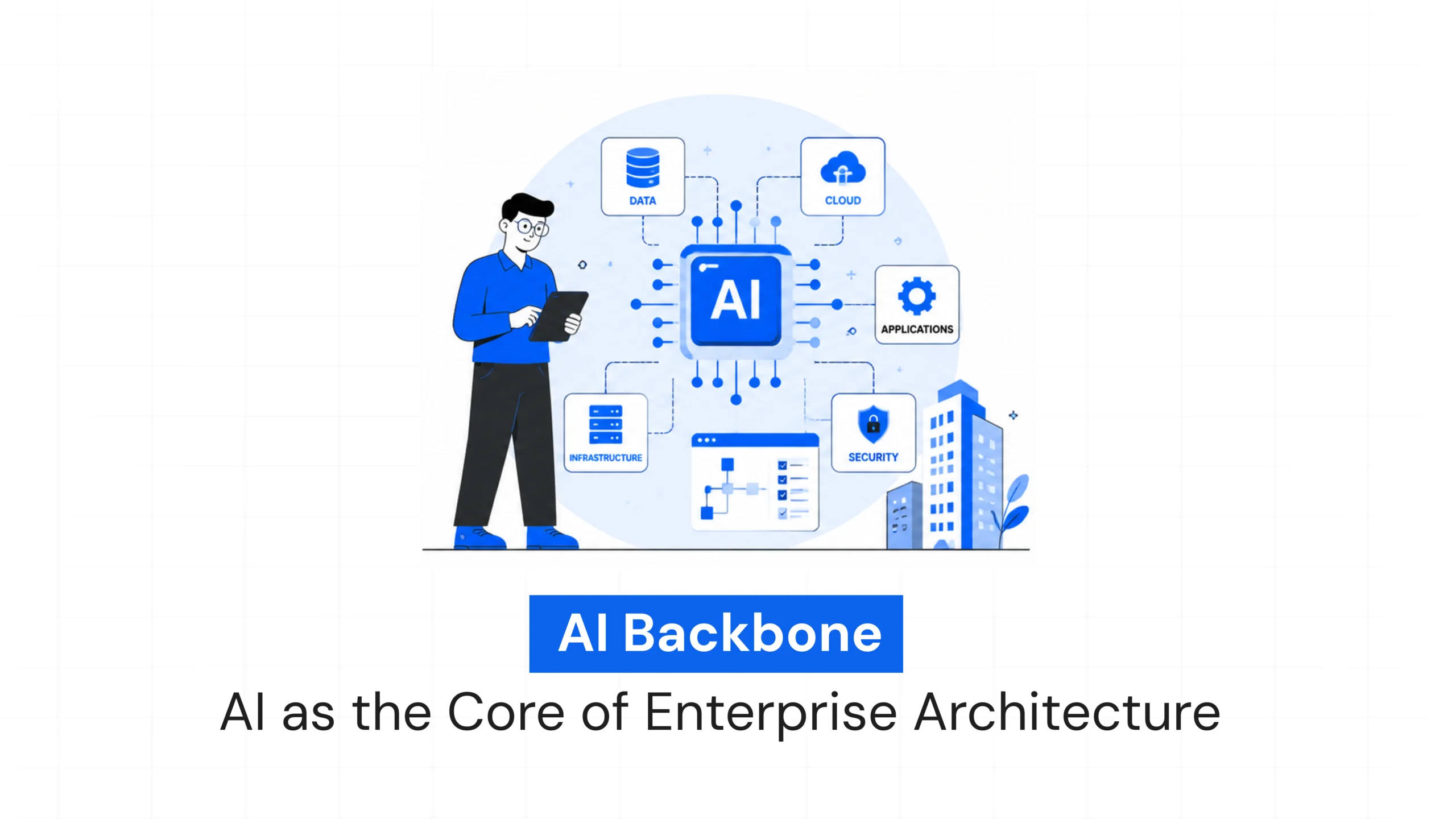
AI Backbone: AI as the Core of Enterprise Architecture
- May 11, 2026
- Pavithra R
- 10:00 am
Post Views: 140
Introduction
By 2026, Artificial Intelligence shifts from background tool to core structure in business tech setups. Instead of only handling repetitive tasks or data review, it drives how companies run day to day. Operations, workflow paths, choices based on information, and large software environments now fold AI into their base layers. Efficiency climbs, systems stretch further, output grows – quiet changes with deep effect.
Picture this: companies aren’t just adding AI on top anymore. Intelligence now flows through every part like water in pipes. Whole systems grow around smarts baked in from the start. Think less add-on, more built-in heartbeat. Operations breathe differently when brains are everywhere. Not a feature – more like the air they run on. The shift feels quiet but changes everything.
Understanding the Core of Artificial Intelligence Systems?
Inside a company’s tech setup, artificial intelligence runs things behind the scenes. It links different systems together smoothly. This core piece handles data flow between departments. Think of it like wiring that carries smart decisions everywhere. One system talks to another through this brain-like hub. Information moves faster because of how everything connects here. The whole structure depends on this thinking center working well
- Workflows
- Enterprise systems Data
- Workflows
- Automation
- Decision-making
- Employee productivity
Just as the spine holds up a person, artificial intelligence keeps different parts of a company working together smoothly. Instead of one team acting alone, systems connect through smart automation that links tasks across units. A central role emerges not by force but by constant alignment, guiding actions without taking control. Like bones support movement, this tech enables flow – between groups, between goals, between effort and result.
AI-powered enterprise systems can:
- Automate repetitive tasks
- Analyze business data in real time
- Improve operational efficiency
- Predict business risks
- Support faster decision-making
Enterprises Shift to AI Native Architecture
Older business software usually has trouble handling:
- Manual workflows
- Slow operations
- Disconnected systems
- Delayed insights
- Increasing operational complexity
When companies grow, such constraints begin chipping away at performance while dragging progress through the mud.
AI helps organizations overcome these challenges by enabling:
- Intelligent automation
- Predictive analytics
- Real-time insights
- Adaptive workflows
- Smarter resource management
Out here, companies are moving beyond rigid structures – now they function more like living networks. Intelligence weaves through daily operations, changing how things take shape. Step by step, old routines dissolve as responsiveness takes hold. What once stood fixed now adapts, learns, reacts. Inside these evolving setups, flow matters more than form.
AI in Business Workflows
Few workplaces run without some form of smart software helping out behind the scenes.
Common Enterprise AI Applications
- AI-powered customer support
- Predictive analytics
- Workflow automation
- Intelligent dashboards
- AI-driven reporting
- Employee productivity assistants
For example:
- AI systems can automatically prioritize support requests.
- Faults might show up early when machines learn what to watch for.
Noticing small signs ahead of time changes how teams respond later.
- AI dashboards can generate real-time business insights for leadership teams.
With these tools, teams move faster while making fewer mistakes. Efficiency grows because tasks flow more smoothly. What happens is work
gets done with less wasted effort. Through better control, results become
more reliable over time.
The Rise of AI Agents
What’s catching on fast in business tech?
AI agents are showing up everywhere. A shift building quietly but
wide across companies.
- Understanding tasks
- Automating workflows
- Assisting employees
- Learning from interactions
- Making context-aware recommendations
When things shift at work, AI agents adjust on their own instead of sticking to fixed rules. They tweak how tasks get done without needing constant updates.
Organizations are increasingly using AI agents in:
- Customer service
- IT operations
- HR management
- Finance
- Internal knowledge systems
Working Together Humans and Artificial Intelligence
Some tasks stay with people. Still, companies now mix human effort alongside smart systems. Machines handle pieces here and there.
Yet judgment often rests with workers.
Teams adjust routines slowly. Meanwhile, technology fits into daily steps. Notevery role changes atonce. Certain jobs shift more than others. People guide outcomes while tools assist. This balance shapes how work flows today.
AI handles:
- Repetitive tasks
- Data analysis
- Monitoring
- Predictive operations
Still, people stay in charge:
- Strategic decisions
- Creativity
- Leadership
- Ethical judgment
- Complex problem-solving
With this mix, companies get more done without losing personal control.
AI Challenges in Business Systems
Though AI brings big benefits, companies still run into hurdles along the way
Data privacy concerns
- Security risks
- AI governance
- Integration complexity
- Infrastructure modernization
To successfully build AI-native enterprises, organizations need:
- Strong governance frameworks
- Secure infrastructure
- Responsible AI policies
- Reliable enterprise data systems
Starting well means setting clear rules early. A solid setup grows stronger over time when guided by steady oversight. Without structure, even smart systems stumble down the road. Clear choices today support bigger results tomorrow. How things begin shapes how far they go.
The Future of Enterprise Architecture
The future of enterprise architecture is becoming:
- AI-native
- Intelligent
- Autonomous
- Predictive
- Scalable
Businesses are moving toward:
- Autonomous workflows
- AI-powered operations
- Intelligent enterprise ecosystems
- Real-time decision systems
Faster machines thinking ahead might soon run how companies work every day. Instead of just helping out, smart systems could shape decisions from the ground up.
Conclusion
Out front, artificial intelligence shifts fast now shaping the base layer of how Companies design their tech setups. Instead of just helping out behind the scenes, it’s built right into daily tasks, moving through processes, guiding choices, while making room for growth without breaking rhythm.
Enterprises that successfully adopt AI-native architecture will gain:
- Faster operations
- Better decision-making
- Improved efficiency
- Greater scalability
- Long-term competitive advantage
Futuristic machines won’t just assist company operations they’ll run them
entirely.
Latest Blogs
Agentic AI vs Generative AI: What’s the Difference?
October 1, 2026
AI Observability: How to Monitor and Manage AI Systems in Production
September 16, 2026
Schedule your free consultation and get expert guidance
FAQ
What is an AI Backbone?
An AI Backbone is an enterprise architecture model where AI acts as the central intelligence layer connecting systems, workflows, and business operations.
Why is AI important in enterprise architecture?
AI helps organizations automate workflows, improve efficiency, generate predictive insights, and enable faster decision-making.
What are AI-native enterprises?
AI-native enterprises are organizations that build their systems and workflows around AI technologies instead of using AI as an additional feature.
What are AI agents?
AI agents are intelligent systems that can automate tasks, assist employees, and optimize enterprise workflows dynamically.
Will AI replace humans in enterprises?
No. AI enhances productivity by handling repetitive tasks, while humans continue to manage strategy, creativity, and leadership.
What are the challenges of implementing AI in enterprises?
Common challenges include data security, governance, infrastructure modernization, integration complexity, and ethical AI management.
What is the future of AI in enterprise architecture?
The future of enterprise architecture will become increasingly AI-native, intelligent, and autonomous, with AI integrated across enterprise operations and decision-making systems.