
Artificial Intelligence is moving beyond simply answering questions and generating content. Today, AI systems are becoming more capable of understanding goals, making decisions, using tools, and completing tasks with less human involvement.
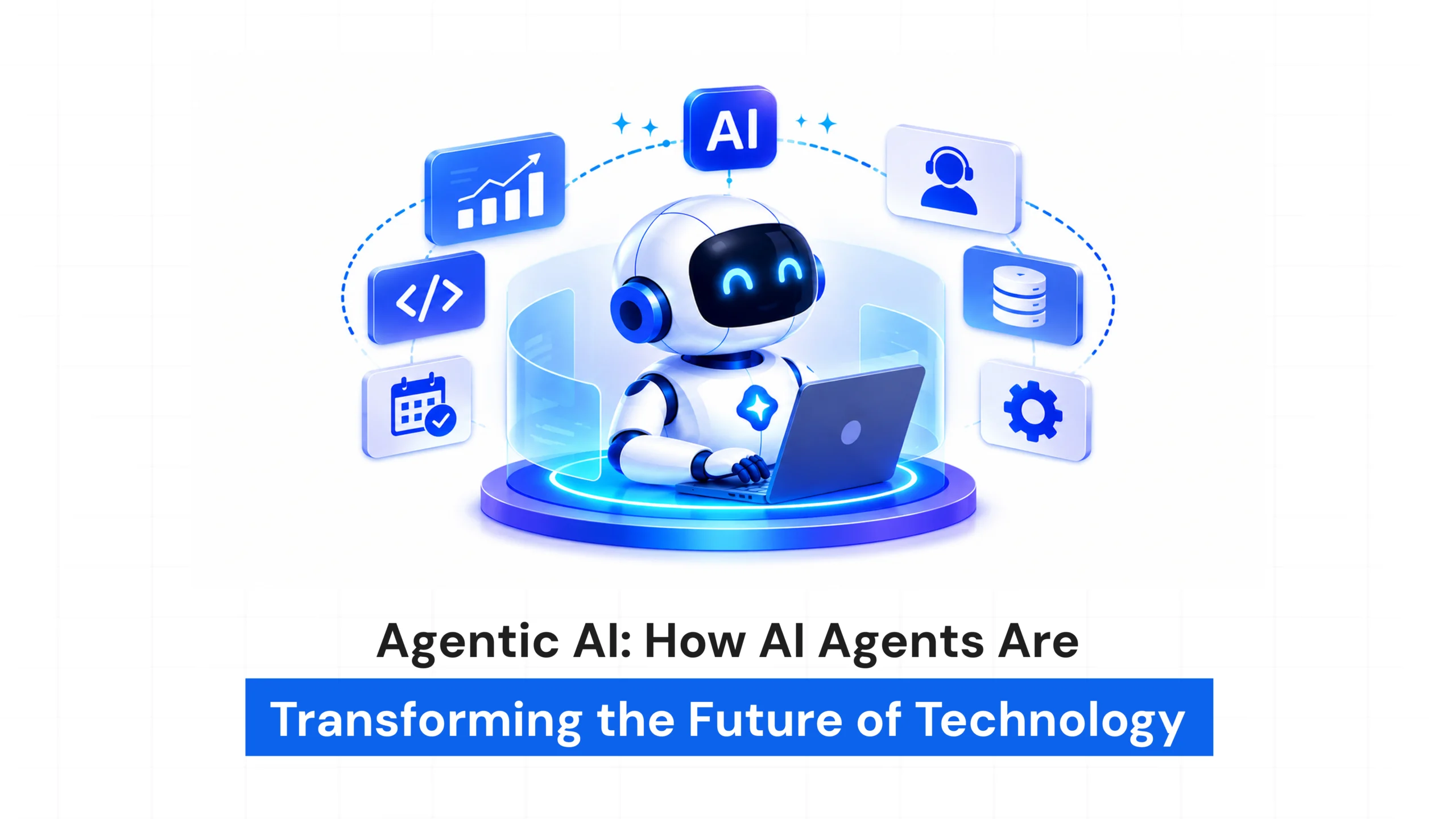
Agentic AI: How AI Agents Are Transforming the Future of Technology
- November 4, 2026
- Pavithra R
- 10:00 am
Views: 5
Introduction
Artificial Intelligence is moving beyond simply answering questions and generating content. Today, AI systems are becoming more capable of understanding goals, making decisions, using tools, and completing tasks with less human involvement.
This shift is bringing Agentic AI into the spotlight.
Unlike traditional AI applications that mainly respond to instructions, Agentic AI can plan steps, select tools, and adjust its approach to achieve a specific goal.
From business automation to software development and customer support, AI agents are changing how people interact with technology.
But what exactly is Agentic AI, and why is it becoming important?
What Is Agentic AI?
Agentic AI refers to AI systems that can work toward specific goals by making decisions, planning actions, and interacting with external tools or systems.
Instead of waiting for instructions at every step, an AI agent can understand a task, break it into smaller steps, and work toward completing it.
For example, a traditional AI chatbot can suggest a travel itinerary. An Agentic AI system could research destinations, compare flights, check hotels, and organize a travel plan using connected tools.
The key difference is simple:
Agentic AI focuses on completing tasks, not just generating responses.
How Does Agentic AI Work?
Agentic AI combines several capabilities to complete tasks with limited human intervention.
- Understanding the Goal
The AI agent identifies what the user wants to achieve.
- Planning the Steps
It breaks the request into smaller tasks and determines how to approach them.
- Using Tools and Data
The agent connects with relevant tools, databases, APIs, or business applications to collect information.
- Taking Action
Based on the available information, it performs the required tasks within its assigned permissions.
- Reviewing the Results
The agent evaluates the outcome and adjusts its approach when necessary.
This process allows AI systems to handle more complex workflows instead of treating every request as a separate interaction.
Agentic AI vs Traditional AI
Traditional AI systems are generally designed to respond to specific inputs. They can answer questions, recognize patterns, generate content, and make predictions.
Agentic AI takes this further by combining planning, reasoning, and tool usage to complete multi-step tasks.
For example:
- Traditional AI: Suggests improvements for a business report.
- Agentic AI: Collects business data, analyzes performance, and prepares a report.
The main difference is that Agentic AI is designed around goal-oriented workflows where multiple actions work together to achieve a result.
Real-World Applications of Agentic AI
Agentic AI is finding applications across different industries.
- Customer Support
AI agents can retrieve customer information, check order status, answer common questions, and escalate complex issues to human support teams.
- Software Development
AI agents can assist developers with code reviews, debugging, testing, and identifying potential issues.
- Healthcare
AI can support administrative tasks such as managing appointments, organizing patient information, and preparing documentation.
- Business Automation
Organizations can use AI agents to process requests, organize documents, generate reports, and manage repetitive workflows.
- E-commerce
AI agents can help customers discover products, compare options, track orders, and receive personalized recommendations.
Key Benefits of Agentic AI
Agentic AI offers several advantages for businesses and technology teams.
Improved Productivity: Automates repetitive tasks and allows employees to focus on important responsibilities.
Faster Decision-Making: Collects and organizes information to support quicker business decisions.
Better Scalability: Helps organizations expand automated workflows as business requirements grow.
Reduced Manual Work: Handles routine processes and saves time across teams.
Flexible Workflows: Adjusts its approach based on task requirements and available information.
These benefits depend on the quality of the AI system, its integrations, and the controls surrounding its actions.
Challenges of Agentic AI
Despite its potential, Agentic AI also comes with challenges.
Data Security and Privacy
AI agents may access sensitive business information. Proper permissions and security controls are essential.
Unreliable Decisions
AI agents can misunderstand instructions or produce incorrect results. Important actions need appropriate validation.
Human Oversight
Allowing agents to perform high-impact actions without approval can create unnecessary risks.
Integration Complexity
Connecting AI agents with existing business applications and databases requires careful technical planning.
Addressing these challenges is important for building reliable AI systems.
The Future of Agentic AI
Agentic AI is expected to play an increasingly important role in how businesses develop and use technology.
As AI models and integrations improve, agents will become more capable of managing complex workflows and collaborating with other specialized agents.
Some emerging areas include:
- Multi-agent collaboration
- Personalized AI assistants
- Intelligent business automation
- AI-powered software development
- Enterprise workflow management
Technologies such as Model Context Protocol (MCP) and Agent2Agent (A2A) are also helping AI agents connect with external tools and communicate with one another.
The future is not necessarily about replacing people with AI. It is about creating better ways for people and intelligent systems to work together.
Final Thoughts
Agentic AI represents an important step in the evolution of artificial intelligence.
Instead of simply generating answers, AI systems can now plan tasks, use connected tools, and work toward specific goals.
For businesses, this creates opportunities to improve productivity, simplify operations, and build more intelligent digital experiences.
However, successful adoption requires reliable integrations, data protection, human oversight, and clear security policies.
The future of technology is not just about AI that can think. It is about AI that can take meaningful action and turn ideas into results.
Latest Blogs
MCP for Enterprise: Governance, SSO, and Access Control Explained
October 15, 2026
Agentic AI vs Generative AI: What’s the Difference?
October 1, 2026
Schedule your free consultation and get expert guidance
FAQs
What is Agentic AI in simple terms?
Agentic AI refers to AI systems that can understand goals, plan steps, use tools, and perform tasks with limited human intervention.
How is Agentic AI different from Generative AI?
Generative AI focuses on creating content such as text, images, and code. Agentic AI focuses on completing tasks through planning, decision-making, and tool usage.
Where is Agentic AI used?
It can be used in customer support, software development, healthcare administration, business automation, e-commerce, and research.
Can Agentic AI work without human involvement?
AI agents can perform certain tasks independently within defined permissions. However, human supervision remains important for sensitive or high-impact decisions.
What are the main benefits of Agentic AI?
The main benefits include improved productivity, reduced manual work, faster workflows, better scalability, and support for complex business operations.
Is Agentic AI the future of technology?
Agentic AI is an important direction in AI development. As these systems become more capable and reliable, they are likely to play a larger role in business operations and everyday digital experiences.