
AI agents are becoming more capable of handling complex tasks. Instead of simply answering questions, they can access external tools, retrieve information, and collaborate with other AI systems to complete a goal.
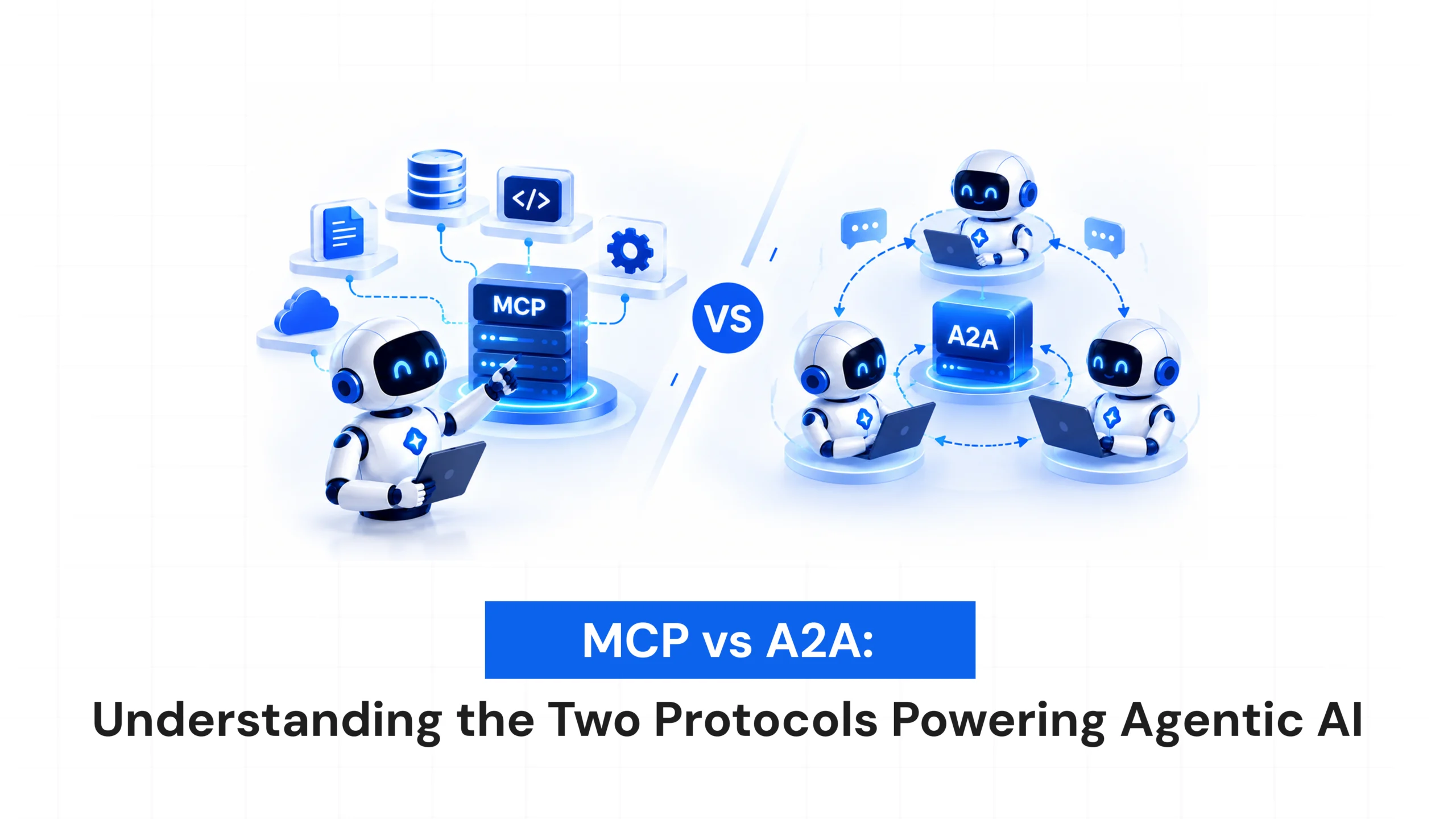
MCP vs A2A: Understanding the Two Protocols Powering Agentic AI
- October 26, 2026
- Pavithra R
- 10:00 am
Views: 4
Introduction
AI agents are becoming more capable of handling complex tasks. Instead of simply answering questions, they can access external tools, retrieve information, and collaborate with other AI systems to complete a goal.
But for AI agents to work effectively, they need a reliable way to connect with tools and communicate with other agents.
This is where two protocols come into the picture: Model Context Protocol (MCP) and Agent2Agent (A2A).
Although both support the development of agentic AI systems, they solve different problems. MCP helps AI applications connect with tools and data, while A2A enables AI agents to communicate and collaborate with one another.
Understanding the difference can help businesses design AI systems that are more connected, flexible, and scalable.
What Is MCP?
Model Context Protocol (MCP) is an open protocol that allows AI applications to connect with external tools, services, and data sources through a standardized interface.
Without a common protocol, developers may need to build separate integrations for different AI applications and business systems.
MCP helps simplify these connections.
For example, an AI assistant might need to retrieve information from a company database, search internal documents, or interact with a CRM platform. An MCP server can expose the relevant tools and resources to the AI application.
Common MCP use cases include:
- Connecting AI assistants to databases and APIs
- Retrieving information from internal knowledge bases
- Accessing files and business applications
- Supporting development and automation tools
- Providing AI agents with access to external capabilities
The main idea is simple: MCP connects AI applications with the tools and information they need.
What Is A2A?
Agent2Agent (A2A) is an open protocol introduced by Google to enable AI agents to communicate and collaborate with one another.
In complex workflows, a single AI agent may not have all the capabilities needed to complete a task. Different agents may specialize in research, data analysis, customer support, or other functions.
A2A provides a standardized way for these agents to interact and coordinate work.
For example, imagine a business wants to prepare a market research report.
One AI agent could gather market information, another could analyze the findings, and a third could help prepare the final report.
Using an appropriate agent-to-agent communication mechanism, these specialized agents can exchange task information and coordinate their contributions.
A2A is designed to support collaboration between agents, including agents built using different frameworks or platforms.
The main idea is simple: A2A helps AI agents communicate and work together.
MCP vs A2A: What Is the Difference?
The key difference lies in what each protocol connects.
MCP focuses on connecting AI applications to tools and data.
It helps an AI application discover and use capabilities exposed by MCP servers.
A2A focuses on communication between AI agents.
It helps agents coordinate tasks and collaborate with other agents that may have different capabilities.
Think of a travel-planning assistant.
With MCP, the assistant could access a flight search tool, retrieve hotel information, or check a connected booking system.
With A2A, the travel-planning agent could collaborate with specialized flight, hotel, and itinerary agents to organize a complete travel plan.
In short, MCP helps an AI agent access capabilities, while A2A helps it collaborate with other agents.
How MCP and A2A Work Together
MCP and A2A are not competing technologies. They can complement each other within the same AI architecture.
Imagine an enterprise building an AI-powered customer support system.
The system could use A2A to coordinate work between a customer support agent, an order investigation agent, and a refund assessment agent.
Meanwhile, individual agents could use MCP to access order databases, customer records, internal policies, and other approved tools.
A simplified workflow might look like this:
- A customer submits a request.
- A support agent identifies the issue.
- A2A enables collaboration with a specialized agent when needed.
- MCP provides access to relevant business tools and information.
- The agents process the available information and prepare an outcome.
- The system responds or requests human approval for sensitive actions.
The exact workflow depends on the system design, available integrations, and security permissions.
Together, these protocols can help developers build AI systems that interact with business tools and coordinate work across specialized agents.
Real-World Use Cases
Enterprise Automation
MCP can connect AI agents to internal systems, while A2A can coordinate multiple agents working on different parts of a business process.
Customer Support
An agent can use MCP to retrieve customer information and support documentation. A2A can help coordinate specialized agents responsible for troubleshooting, order status, or other support tasks.
Research and Analysis
MCP can provide access to approved data sources and research tools. A2A can help coordinate agents that gather information, analyze findings, and prepare reports.
Software Development
MCP can connect AI development tools to repositories, documentation, and testing systems. A2A can support collaboration between specialized coding, testing, and review agents.
These are examples of how the protocols can be combined; the actual capabilities depend on the tools and agents available.
Benefits of Using MCP and A2A Together
Using both protocols can help organizations build more flexible AI architectures.
Better integration: MCP provides a standardized way to expose tools and data to AI applications.
Improved collaboration: A2A enables agents to coordinate tasks across different systems and frameworks.
Modular architecture: Developers can build specialized agents and connect them without placing every responsibility in a single system.
Greater flexibility: Organizations can expand their AI workflows by adding new tools or agents as requirements change.
More complex automation: The combination can support workflows that require both access to business systems and collaboration between multiple agents.
However, the benefits depend on good system design, reliable integrations, appropriate permissions, and effective monitoring.
What Should Businesses Consider?
Before adopting MCP or A2A, businesses should identify the problem they want to solve.
If the main requirement is connecting an AI application to databases, APIs, files, or business tools, MCP may be the appropriate starting point.
If the requirement involves multiple AI agents communicating and coordinating tasks, A2A may be more relevant.
For workflows that need both capabilities, organizations can consider using the protocols together.
Security should also be a priority. Businesses need appropriate authentication, access controls, data protection, monitoring, and human oversight for high-impact actions.
Choosing a protocol should depend on the architecture and business requirements, rather than simply following the latest AI trend.
Final Thoughts
As AI systems evolve, their ability to connect with tools and collaborate with other agents is becoming increasingly important.
MCP helps AI applications connect with tools and data, while A2A helps AI agents communicate and collaborate.
They address different challenges, but together they can support more capable and flexible agentic AI systems.
For businesses, the opportunity lies in understanding where each protocol fits and how it can support real operational needs.
The future of agentic AI isn’t just about building smarter individual agents. It’s also about creating systems where agents can access the right resources, work together effectively, and complete tasks within clearly defined boundaries.
Latest Blogs
Agentic AI vs Generative AI: What’s the Difference?
October 1, 2026
Schedule your free consultation and get expert guidance
FAQs
What is the main difference between MCP and A2A?
MCP connects AI applications with tools and data sources, while A2A enables communication and collaboration between AI agents.
Are MCP and A2A competitors?
No. They solve different problems and can work together in the same AI system.
Can MCP and A2A be used together?
Yes. MCP can provide access to tools and data, while A2A coordinates communication between specialized agents.
When should businesses use MCP?
MCP is useful when AI applications need standardized access to external tools, APIs, databases, files, or business systems.
When should businesses use A2A?
A2A is useful when multiple AI agents need to communicate, coordinate tasks, or collaborate across different platforms or frameworks.
Why are MCP and A2A important for agentic AI?
They address two important requirements for agentic systems: connecting AI to external capabilities and enabling agents to work together on complex tasks.