
Artificial intelligence is moving beyond simple chatbots and content generation.
Generative AI has already changed how businesses create content, analyze information, write code, and communicate with customers. Now, Agentic AI is taking the next step by helping AI systems plan tasks, use tools, and work toward specific goals.
Agentic AI vs Generative AI: What’s the Difference?
- October 1, 2026
- Pavithra R
- 10:00 am
Post Views: 4
Introduction
Artificial intelligence is moving beyond simple chatbots and content generation.
Generative AI has already changed how businesses create content, analyze information, write code, and communicate with customers. Now, Agentic AI is taking the next step by helping AI systems plan tasks, use tools, and work toward specific goals.
But what exactly is the difference?
In simple terms:
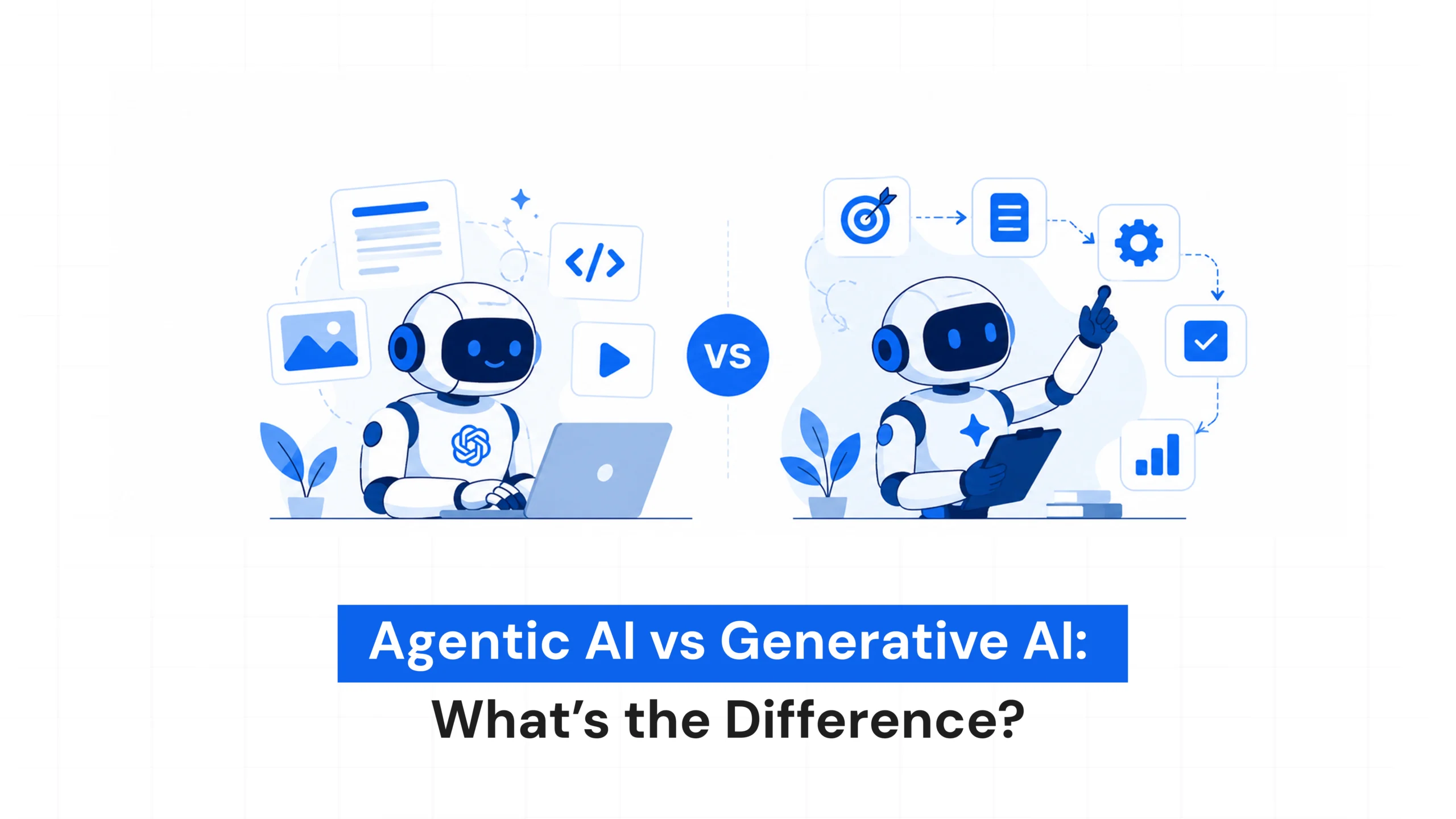
Generative AI creates. Agentic AI acts.
The two technologies are closely connected, and businesses can use them together to build smarter and more automated workflows.
What Is Generative AI?
Generative AI is designed to create new content based on a user’s instructions.
It can generate:
- Text
- Images
- Code
- Audio
- Video
- Summaries
- Reports
For example, a marketer could ask:
“Write a product description for a new smartphone.”
The AI processes the request and generates the content.
The basic process is simple:
Prompt → AI → Output
Generative AI is especially useful when the goal is to create, transform, or summarize information.
What Is Agentic AI?
Agentic AI goes beyond simply generating a response.
Instead of responding to one instruction at a time, an AI agent can be designed to work toward a broader goal.
For example:
“Find potential customers, research their companies, update the CRM, and prepare follow-up emails.”
An agentic system can potentially break this goal into smaller tasks, use connected tools, evaluate the results, and continue through the workflow.
A simplified process looks like:
Goal → Plan → Act → Observe → Decide → Outcome
This ability to work through multiple steps is what makes Agentic AI particularly interesting for business automation.
The Key Difference Between Agentic AI and Generative AI
The easiest way to understand the difference is to look at what each system is expected to do.
Generative AI is mainly focused on producing an output.
You give it a prompt, and it creates something based on that instruction.
For example:
“Write a blog introduction about AI automation.”
The AI generates the introduction.
Agentic AI is focused on achieving an outcome.
Instead of asking it to create one specific thing, you give it a goal.
For example:
“Research AI automation trends and prepare a report for our marketing team.”
The agent may need to gather information, analyze it, organize the findings, create the report, and complete other steps required to reach the goal.
The difference can be summarized simply:
Generative AI → Create
Agentic AI → Plan + Act + Complete
A Simple Real-World Example
Imagine a customer support team.
With Generative AI
An employee receives a customer complaint and asks:
“Write a response to this customer.”
The AI generates a suitable response.
The employee reviews it and sends it.
With Agentic AI
The instruction could be:
“Handle this customer complaint.”
Depending on the system’s permissions and integrations, an agent could potentially:
- Read the complaint
- Check the customer’s order
- Identify the issue
- Find the relevant policy
- Prepare a response
- Update the support ticket
- Escalate the case when required
The first system helps create the response.
The second system can potentially work through the entire workflow.
How Agentic AI and Generative AI Work Together
Agentic AI doesn’t replace Generative AI.
In fact, many agentic systems can use Generative AI as one of their core capabilities.
Imagine an AI agent handling a customer request.
It may need to:
- Understand the customer’s message
- Search for relevant information
- Analyze the information
- Generate a response
- Update a business system
- Decide what should happen next
Generative AI can help with understanding and generating content.
The agentic layer can coordinate the larger workflow.
This makes the two technologies complementary rather than competitors.
Where Generative AI Works Best
Generative AI is particularly useful when the main requirement is creating or transforming information.
Content Creation
Generate blog posts, social media content, product descriptions, emails, and marketing copy.
Document Summarization
Turn lengthy reports, meeting notes, or documents into shorter summaries.
Software Development
Generate code, explain existing code, create documentation, and support developers.
Creative Work
Create ideas, scripts, images, concepts, and other creative content.
Knowledge Assistance
Help employees understand information and find answers using natural language.
If the requirement is:
“Create something for me.”
Generative AI is often the right starting point.
Where Agentic AI Works Best
Agentic AI becomes more useful when a task involves multiple steps, decisions, or systems.
Customer Support
Manage tickets, find relevant information, prepare responses, and escalate cases.
Sales
Research prospects, qualify leads, update CRM records, and prepare follow-ups.
IT Operations
Analyze alerts, investigate issues, and route incidents to the right teams.
Finance
Process documents, identify exceptions, and support reconciliation workflows.
Business Operations
Move information between systems and automate repetitive processes.
If the requirement is:
“Complete this process for me.”
An agentic approach may be more appropriate.
Benefits of Generative AI
Generative AI can help businesses:
- Create content faster
- Reduce repetitive writing
- Generate ideas
- Summarize information
- Support software development
- Improve employee productivity
- Personalize content
Its biggest strength is creating and transforming information quickly.
Benefits of Agentic AI
Agentic AI focuses more on completing workflows.
It can potentially help businesses:
- Automate multi-step processes
- Reduce repetitive manual work
- Connect different business systems
- Speed up operational workflows
- Handle routine decisions
- Reduce manual handoffs
Its biggest strength is coordinating actions toward a defined goal.
What Businesses Should Consider
Greater AI autonomy also comes with greater responsibility.
Before implementing Agentic AI, businesses should consider:
- Data security
- Access permissions
- Human oversight
- Accuracy
- Privacy
- Monitoring
- Error handling
- System integrations
- Compliance
An AI system that only creates a draft has limited operational impact.
An AI system that can update records, communicate with customers, or trigger business processes requires stronger controls.
The goal should not be to give AI unlimited control.
Instead, businesses should define where AI can act, what it can access, and when a human needs to step in.
Which One Should Businesses Use?
There is no single answer.
It depends on the problem you’re trying to solve.
Choose Generative AI when you need to:
- Create content
- Summarize information
- Generate ideas
- Write or explain code
- Transform existing content
Consider Agentic AI when you need to:
- Automate multi-step processes
- Connect multiple tools
- Perform actions based on conditions
- Work toward a specific business goal
- Reduce repetitive operational work
In many cases, businesses can benefit from using both together.
The Future of AI: From Creation to Action
Generative AI changed how people interact with technology.
Instead of navigating complex tools or searching through large amounts of information, people can simply describe what they need.
Agentic AI takes this idea further.
The focus is gradually moving from:
“AI, give me an answer.”
to:
“AI, help me get this done.”
This doesn’t mean every business process should become fully autonomous.
Human oversight will remain important, especially when AI is dealing with sensitive data, financial decisions, customer communications, or other high-impact workflows.
But for repetitive and structured processes, Agentic AI can create new opportunities for automation.
Final Thoughts
Generative AI and Agentic AI solve different problems.
Generative AI is focused on creation.
Agentic AI is focused on planning, action, and workflow execution.
The real opportunity for businesses isn’t necessarily choosing one over the other.
It’s understanding where each technology can add value.
Generative AI can help teams create faster.
Agentic AI can help businesses automate more and move work forward.
Together, they represent an important shift in AI — from systems that simply generate answers to systems that can become active participants in how work gets done.
Latest Blogs
AI Observability: How to Monitor and Manage AI Systems in Production
September 16, 2026
How AI Agents Are Transforming the Future of SaaS
September 10, 2026
Schedule your free consultation and get expert guidance
FAQs on Agentic AI
Is Agentic AI the same as Generative AI?
No. Generative AI primarily creates content, while Agentic AI is designed to work toward goals through planning, decision-making, and actions.
Can Agentic AI use Generative AI?
Yes. Generative AI can provide capabilities such as language understanding, reasoning, summarization, and content generation within an agentic system.
Is Agentic AI better than Generative AI?
Neither is universally better. They are designed for different use cases. Generative AI works well for creation and information-based tasks, while Agentic AI is more suited to multi-step workflows and automation.
What is the main benefit of Agentic AI?
Its ability to work through multiple steps toward a defined goal can help businesses automate workflows rather than individual tasks.
Will Agentic AI replace Generative AI?
No. Agentic AI can use Generative AI as part of its underlying capabilities. The two technologies are more complementary than interchangeable.