
AI systems can perform well during development and testing, but keeping them reliable after deployment is a different challenge. Once an AI application is being used by real customers, teams need to understand more than whether the system is running. They need to know how the AI is responding, where it is failing, how quickly it processes requests, and whether its outputs remain accurate and useful over time.
AI Observability: How to Monitor and Manage AI Systems in Production
- September 16, 2026
- Pavithra R
- 10:00 am
Post Views: 3
Introduction
AI systems can perform well during development and testing, but keeping them reliable after deployment is a different challenge. Once an AI application is being used by real customers, teams need to understand more than whether the system is running. They need to know how the AI is responding, where it is failing, how quickly it processes requests, and whether its outputs remain accurate and useful over time.
This is where AI observability becomes important.
AI observability gives development and operations teams visibility into the behavior of AI systems in real-world environments. By monitoring performance, responses, errors, costs, and other important signals, teams can identify problems earlier and continuously improve the system.
WHAT IS AI OBSERVABILITY?
AI observability is the practice of monitoring and understanding the performance and behavior of AI systems after they are deployed.
Traditional application monitoring usually focuses on areas such as server health, response time, memory usage, and error rates. AI systems require a broader view because their outputs can change depending on the input, model, context, and data being processed.
For example, an AI application may be technically available but still provide poor or inaccurate responses to users. Without proper observability, identifying the reason behind the change can be difficult.
AI observability helps teams connect system performance with AI behavior, making it easier to understand what is happening and why.
WHY AI OBSERVABILITY MATTERS IN PRODUCTION
AI systems operate in environments that can change continuously. User inputs evolve, data changes, models are updated, and integrations can behave differently over time.
A system that performed well during testing may therefore behave differently once it starts handling real-world traffic.
Observability helps teams detect these changes instead of waiting for users to report problems. It provides visibility into issues such as unexpected model responses, increasing latency, failed requests, rising costs, or changes in output quality.
For businesses, this visibility is important because AI is often connected to customer experiences and business processes. A small issue in an AI workflow can affect user satisfaction, operational efficiency, and trust in the product.
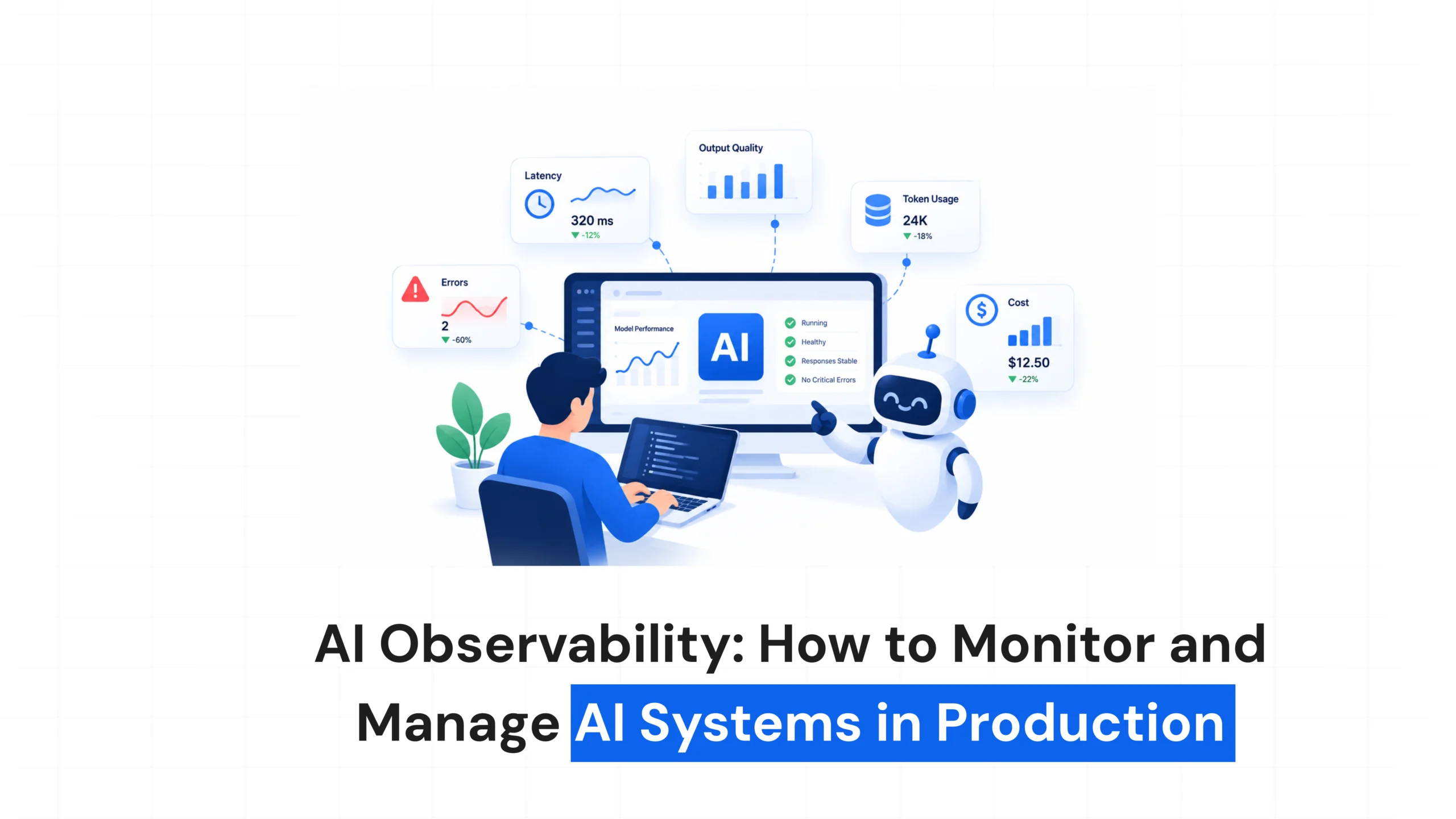
WHAT SHOULD YOU MONITOR IN AN AI SYSTEM?
Effective AI observability goes beyond simply checking whether the application is online. Teams need to monitor both the technical performance of the system and the quality of the AI experience.
MODEL PERFORMANCE
Model performance helps teams understand whether an AI system is producing useful and consistent results.
Depending on the application, teams may monitor response quality, accuracy, relevance, hallucination rates, or task-specific evaluation metrics. These measurements help identify whether the model continues to perform as expected after deployment.
LATENCY AND RESPONSE TIME
Users expect AI applications to respond quickly. Monitoring latency helps teams understand how long requests take from input to response.
High latency can be caused by model processing, external APIs, database operations, network issues, or increased traffic. Tracking these factors helps teams identify bottlenecks and improve the overall user experience.
ERRORS AND FAILURES
AI applications can fail for many different reasons. Requests may time out, APIs may become unavailable, prompts may produce unexpected results, or supporting services may fail.
Monitoring errors and failures allows teams to identify recurring issues and investigate them before they affect a larger number of users.
TOKEN USAGE AND COST
For applications using large language models, token consumption can directly affect operating costs.
Monitoring input and output tokens, model usage, request volume, and cost per request helps teams understand where resources are being used. This information can also help teams optimize prompts, model selection, and application architecture.
OUTPUT QUALITY
Technical performance alone does not tell the complete story.
An AI system may have excellent uptime and fast response times while still producing inaccurate or irrelevant answers. Monitoring output quality helps teams understand whether the system is actually delivering useful results to users.
HOW AI OBSERVABILITY WORKS
AI observability typically brings together data from different parts of the AI application and presents it in a way that development and operations teams can analyze.
When a user sends a request, teams may track information about the input, model used, processing steps, response time, output, errors, and other relevant events.
This creates a trace of what happened during the request.
When something goes wrong, developers can use these traces and logs to understand where the issue occurred. Instead of looking at a single error message, they can follow the complete journey of a request through the AI system.
This makes troubleshooting more practical, especially for applications that involve multiple models, APIs, databases, or AI agents.
COMMON CHALLENGES IN MONITORING AI SYSTEMS
Monitoring AI systems can be more complex than monitoring traditional applications because AI behavior is not always predictable.
One challenge is identifying changes in output quality. A model may continue responding successfully while gradually producing less accurate or less relevant results.
Another challenge is data and model drift. Changes in user behavior or input data can affect how well a model performs over time.
There are also security and privacy considerations. AI observability systems may capture prompts, responses, metadata, or other information that could contain sensitive data. Teams therefore need appropriate access controls, data protection, and retention policies.
BEST PRACTICES FOR AI OBSERVABILITY
AI observability works best when it is built into the development and deployment process rather than added only after a problem appears.
Teams should define the important metrics for their specific AI application and establish clear expectations for performance and output quality. Logs and traces should provide enough context to investigate issues without unnecessarily storing sensitive information.
Regular evaluations are also important. AI output should be tested against relevant scenarios to identify quality changes that traditional infrastructure monitoring may not detect.
It is equally important to create alerts for meaningful changes. Too many alerts can create unnecessary noise, while too few can allow important issues to go unnoticed.
The goal is to create a monitoring system that helps teams understand, troubleshoot, and continuously improve their AI applications.
THE FUTURE OF AI OBSERVABILITY
As AI becomes more deeply integrated into business applications, observability will become an increasingly important part of AI operations.
AI systems are also becoming more complex, with multiple models, AI agents, external tools, databases, and automated workflows working together. Monitoring individual components may not be enough to understand the behavior of the complete system.
Future AI observability practices will increasingly focus on connecting technical performance with model behavior, security, cost, and user experience.
This will help organizations move beyond simply asking, “Is the AI system running?” and instead answer more useful questions such as, “Is it working correctly, efficiently, securely, and consistently for our users?”
Conclusion
AI observability provides the visibility needed to operate AI systems confidently in production. By monitoring model performance, latency, errors, costs, and output quality, teams can identify issues earlier and make informed improvements.
The goal is not to collect every possible metric. It is to understand what is happening inside an AI system and have enough information to act when something changes.
As organizations continue adopting AI across products and business processes, observability will play an important role in keeping these systems reliable, efficient, and useful over time.
Latest Blogs
LLM Security: Risks, Defenses, and Best Practices
August 27, 2026
AI-Powered Cyberattacks: What Developers Need to Know
August 18, 2026
Schedule your free consultation and get expert guidance
FAQs
WHAT IS AI OBSERVABILITY?
AI observability is the practice of monitoring and understanding the performance and behavior of AI systems in production. It combines technical monitoring with AI-specific information such as model performance, output quality, latency, errors, and usage.
WHY IS AI OBSERVABILITY IMPORTANT?
AI systems can produce different results depending on inputs, models, and changing data. AI observability helps teams detect performance and quality issues, troubleshoot problems, monitor costs, and maintain reliable AI experiences after deployment.
WHAT METRICS SHOULD BE MONITORED IN AI SYSTEMS?
Important metrics can include response time, error rates, token usage, model performance, output quality, request volume, and operational costs. The specific metrics depend on the type and purpose of the AI application.
HOW CAN TEAMS IMPROVE AI OBSERVABILITY?
Teams can improve AI observability by combining logs, metrics, traces, model evaluations, and meaningful alerts. They should also regularly evaluate AI outputs, protect sensitive information, and define clear performance and quality expectations.