
Artificial intelligence has moved far beyond simple chatbots. Businesses now use AI to analyze data, support customers, automate repetitive work, generate reports, and improve decision-making.
But as AI moves into real business operations, one challenge becomes clear: AI needs access to the systems where the real work happens.
How MCP Servers Are Transforming Enterprise AI Integration
- August 14, 2026
- Pavithra R
- 10:00 am
Post Views: 66
Introduction
Artificial intelligence has moved far beyond simple chatbots. Businesses now use AI to analyze data, support customers, automate repetitive work, generate reports, and improve decision-making.
But as AI moves into real business operations, one challenge becomes clear: AI needs access to the systems where the real work happens.
Traditionally, every AI application required separate integrations with tools, APIs, databases, and business systems. As AI use grows, maintaining all these connections becomes increasingly complex.
This is where Model Context Protocol (MCP) comes in. MCP provides a standardized way for AI applications to connect with external tools, data, and capabilities.
For enterprises, MCP can become an important part of building scalable AI-powered workflows.
What Is MCP?
Model Context Protocol, or MCP, is an open protocol designed to help AI applications connect with external systems, tools, and information.
Think of MCP as a common language between an AI application and the systems it needs to work with.
For example, an employee might ask an AI assistant to analyze sales performance. The AI could need access to a CRM, analytics platform, or database to complete the task.
With MCP, businesses can expose specific capabilities through MCP servers, allowing AI applications to discover and use those capabilities in a standardized way.
MCP can connect AI with:
- Business databases
- Internal documents
- CRM systems
- Analytics platforms
- Enterprise APIs
- Search systems
- Business workflows
MCP does not replace the AI model or the underlying business systems. It provides a standardized way for AI applications to interact with them.
Why Enterprise AI Integration Is Difficult
Enterprise environments are rarely simple. Different departments may use different CRMs, databases, project management tools, analytics platforms, communication systems, and internal applications.
Most of these systems were not originally designed for AI. Connecting them can require custom development, separate APIs, and ongoing maintenance.
As organizations add more AI applications, the number of integrations can quickly become difficult to manage.
Standardized protocols such as MCP can help create a more consistent integration approach.
How MCP Changes the Integration Model
Traditional Approach
AI Application → Custom Integration → Business System
MCP-Based Approach
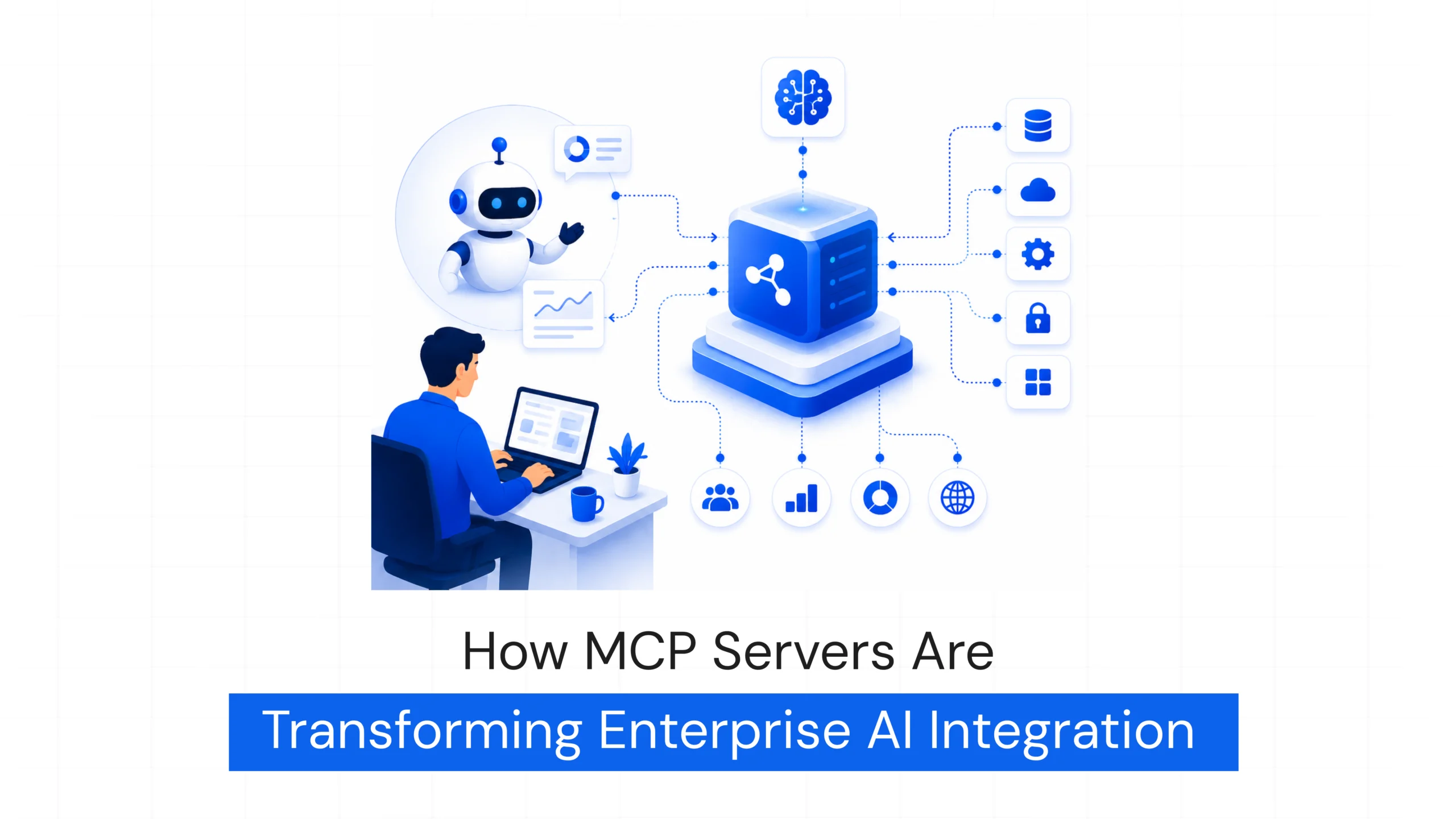
AI Application → MCP → MCP Server → Business System
The MCP server acts as a controlled interface between the AI application and the underlying capability.
MCP does not eliminate integration work. Businesses still need to build, secure, monitor, and maintain their servers. However, the standardized protocol can make integrations more consistent and reusable.
Why MCP Matters for Enterprise AI
- Reduces Integration Complexity
MCP provides a common approach for exposing tools and data to AI applications. This can make it easier to build and maintain integrations as organizations expand their AI use cases.
- Connects AI to Real Business Context
AI models do not automatically know what is happening inside a company. MCP can provide controlled access to information such as customer data, inventory, project status, internal documents, and support tickets.
This allows AI applications to work with information that is relevant to the organization.
- Enables AI to Take Action
The next step for AI is not simply answering questions. AI agents can use connected tools to complete workflows.
For example, an AI agent could:
- Search customer support data
- Identify overdue tickets
- Analyze common issues
- Generate a summary
- Create a report
- Deliver it to the appropriate person
This makes MCP especially relevant to the growth of agentic AI.
- Creates Reusable Capabilities
Businesses can expose reusable capabilities such as:
- Searching customer information
- Retrieving sales data
- Checking inventory
- Searching internal documents
- Generating reports
Different AI experiences can potentially use the same capabilities.
- Supports Flexible AI Experiences
Instead of opening several enterprise applications to complete a task, employees may increasingly describe what they want and allow an AI assistant to coordinate the required systems behind the scenes.
This can make complex enterprise workflows simpler for users.
MCP and the Future of AI Agents
MCP becomes particularly useful as businesses move from conversational AI toward agentic AI.
A chatbot generally answers a question. An AI agent can understand a goal, determine what needs to happen, use tools, and complete a workflow.
Agents may need to:
- Search information
- Read documents
- Query databases
- Call APIs
- Create records
- Update systems
- Trigger workflows
- Request human approval
As AI agents become more capable, reliable access to business systems becomes increasingly important.
Enterprise Security Cannot Be an Afterthought
Giving AI access to enterprise systems creates important security and governance questions.
Businesses should consider:
- Authentication– Who can connect to the MCP server?
- Authorization– What tools and information can each user or AI agent access?
- Data Protection– What sensitive information can be exposed?
- Auditability– Can the organization understand what actions the AI performed?
- Human Approval– Which actions require review before execution?
- Monitoring– Can unusual or harmful activity be detected?
These considerations become even more important when AI moves from reading information to taking actions.
MCP Is Becoming More Enterprise-Ready
The MCP ecosystem is evolving toward production-scale requirements such as reliability, scalability, authorization, routing, caching, long-running tasks, and enterprise governance.
For enterprise teams, this matters because production systems need more than a technology that works in a demo.
They need infrastructure that can scale, predictable authorization, monitoring, and the ability to evolve without rebuilding everything.
MCP Servers and the Changing Role of UX
Although MCP is a technical protocol, it has an important UX impact.
When AI becomes the interface between users and multiple enterprise systems, users may no longer need to understand which application performs each task.
They can simply describe what they want.
For example, a user could ask an AI assistant to identify high-value customers who have not purchased recently and prepare a follow-up list.
The experience becomes less about navigating screens and more about expressing intent.
This creates new UX questions:
- How should AI communicate what it is doing?
- How should users review AI-generated actions?
- When should the system ask for approval?
- How should errors be explained?
- How can users undo an action?
- How much control should users have?
These are UX problems—not just engineering problems.
MCP Apps: Where Integration and Interface Come Together
MCP is also moving beyond backend connectivity.
MCP Apps can allow tools to return interactive UI components inside supported AI conversations.
This creates opportunities for:
- Dashboards
- Forms
- Visualizations
- Multi-step workflows
For designers, this means the future of AI interfaces may not be limited to text.
The right experience could combine conversation with interactive UI, creating a more natural way for users to work with AI-powered systems.
Challenges Businesses Need to Consider
MCP offers significant potential, but it should not be treated as a magic solution.
Businesses need to consider:
Security Risks
AI access to enterprise tools requires carefully controlled permissions.
Poorly Designed Tools
Unclear or overly broad tools can increase confusion and incorrect actions.
Data Quality
AI cannot solve problems caused by inaccurate or outdated business data.
Governance
Organizations need clear policies for deployment, access, actions, and monitoring.
Human Oversight
High-impact actions may require human review.
Integration Maintenance
Underlying systems and exposed capabilities still need ongoing maintenance.
How Businesses Can Prepare for MCP Adoption
Businesses do not need to connect every internal system to AI immediately.
A better approach is to start with one focused, high-value workflow.
Start With One High-Value Workflow
Identify a repetitive process where AI could create measurable value.
Examples include:
- Customer support analysis
- Internal knowledge search
- Sales reporting
- Document processing
- IT service management
- Business intelligence
Identify the Required Tools
Determine which systems the AI needs to access to complete the workflow.
Define Permissions
Decide what the AI can read, what it can write, and which actions require approval.
Design the User Experience
Think about how employees will interact with the AI and how they will understand and control its actions.
Measure the Results
Track whether the implementation saves time, improves accuracy, reduces manual work, or improves customer experience.
The goal should not be to adopt MCP simply because it is new.
The goal should be to use it where it creates meaningful business value.
What MCP Means for the Future of Enterprise Software
Traditional enterprise software is built around applications. Employees open an application, find the right screen, navigate menus, enter information, and complete a task.
AI introduces another possibility.
Employees can describe what they want to accomplish, while AI coordinates the tools and systems required to complete the workflow.
Traditional interfaces will not disappear. People will still need dashboards, forms, reports, settings, and visualizations.
But the role of the interface may change.
The future could be less about which application you use and more about what you want to accomplish.
Why MCP Matters for Digital Product Teams
For product and design teams, MCP represents more than another developer technology. It signals a broader change in how digital products are built.
Product teams may need to think about:
- Designing AI-first workflows
- Making product capabilities discoverable by AI
- Creating clear and structured actions
- Designing human approval points
- Providing transparent AI feedback
- Building interfaces that support both humans and AI agents
- Creating reusable capabilities rather than isolated features
The best AI products will require collaboration between UX design, product strategy, engineering, AI architecture, and people who understand real business processes.
How Kirshi Can Help
At Kirshi, we see AI integration as more than simply adding an AI feature to an existing product.
We help businesses rethink how people interact with digital products and how intelligent systems can work alongside them.
Our expertise across UI/UX design, product design, web design and development, design systems, and digital experiences allows us to approach AI-powered products from both the technology and user perspective.
We help businesses think through questions such as:
- Where can AI genuinely improve the user experience?
- Which workflows should be automated?
- Where should humans remain in control?
- How should AI communicate its actions?
- How can complex enterprise systems become simpler for users?
- How can digital products be designed for an AI-first future?
As MCP makes it easier for AI systems to connect with business capabilities, the next challenge is creating experiences that make those capabilities useful, understandable, and trustworthy.
Final Thoughts
Enterprise AI is moving into a new phase.
The question is no longer simply whether a business can add an AI assistant.
The bigger question is whether AI can actually work with the systems that run the business.
MCP servers provide a standardized way for AI applications to connect with tools, data, and workflows.
As the ecosystem matures, businesses will have more opportunities to build AI experiences that go beyond answering questions and start completing meaningful work.
But technology alone will not determine success.
Security, governance, data quality, human oversight, and UX will all play important roles.
The future of enterprise AI will depend not only on smarter models, but also on how effectively those models connect with the real world of business.
Latest Blogs
How AI Agents Are Transforming the Future of SaaS
September 10, 2026
LLM Security: Risks, Defenses, and Best Practices
August 27, 2026
Schedule your free consultation and get expert guidance
FAQs
What is an MCP server?
An MCP server allows AI applications to connect with external tools, data, and business systems through the Model Context Protocol.
Why is MCP important for enterprise AI?
MCP provides a standardized approach for connecting AI applications with enterprise systems, making integrations more reusable and manageable.
How do MCP servers support AI agents?
MCP gives AI agents a standardized way to discover and use external tools and information needed to complete workflows.
Does MCP replace existing APIs?
No. MCP does not replace APIs. It can provide an AI-friendly layer for capabilities already powered by APIs, databases, and other systems.
How can businesses get started with MCP?
Businesses can begin with one high-value workflow, identify the required systems, define permissions and human approval requirements, and measure the results.